CP
Community Playbook Sure Foundation Brief
Sure Foundation · Jonesboro, AR
Building On The Sure Foundation

Fisher Street COGIC · 2026

Community DiscoveryPlaybook

Discovery Brief for Sure Foundation · Jonesboro, Arkansas

A data‑informed foundation to help Sure Foundation choose which community priority to address first — beginning with a focused, 90‑day play built on what's already at 111 Fisher Street.

Youth Food Security Housing Mental Health
Strategy Session Overview 6:20 MIN
Sure Foundation Explainer Video
Play Overview · 6:20 min

Grant Timing Alert

Blue & You Foundation Behavioral Health LOI window opens July 1–13 — a $25,000–$250,000 opportunity for the Youth Mental Health Pipeline play. This brief is the foundation for that application.

Leadership Toolkit

Four ways to prayerfully discern

Full Discovery Brief

Complete data-informed playbook including three 90-day plays.

Explainer Video

Walkthrough for leaders to grasp the story before the meeting.

Visual Summary

One-page snapshot of priorities, costs, and community impact.

Leadership PPT

Slide deck for board, staff, or congregational presentations.

Before You Choose a Play

The Community Listening Card

The Discovery Brief tells you what the data shows. This step asks what people actually feel. Both are required before Sure Foundation selects a play.

Required Step
1
Review Brief
2
Listen First
3
Choose a Play
4
Close the Loop
5
Launch

The Discovery Brief is a view of Jonesboro from the outside in — ZIP data, school metrics, eviction filings, suicide rates. It is useful. It is not sufficient.

The people whose lives will be most directly affected by the chosen play have not yet spoken. Before a play is selected, their voice needs a seat at the table — not as a formality, but as a form of faithfulness.

Sure Foundation's calling has always been to care with the neighbors at 111 Fisher Street, not merely for them. The Listening Card keeps that posture intact — and makes the data mean something in human terms.

Without listening

The play is built on what leaders assume the community needs. Even when the data is right, the execution often misses — because it was designed without the people it was designed for.

With listening

The play is anchored to real felt needs, in real language, from real neighbors at 111 Fisher Street. The community becomes a partner in the work — not the recipient of it.

Question 1 · Neighborhood Pulse

"What's one word or phrase you'd use to describe what life feels like in this neighborhood right now?"

Opens the conversation. Anyone can answer — whether thriving or struggling.

Question 2 · Felt Need

"If Sure Foundation could do one thing in the next 90 days that would make a real difference — what would it be?"

Hands ownership to the respondent. Surfaces felt need in their language, not yours.

Question 3 · Asset Question

"What's already happening on Fisher Street or in this neighborhood that you think more people should know about?"

Surfaces partners and assets. Signals you're not coming in as a rescuer.

Question 4 · Optional — Use When a Play Is in View

"If we did [play], what would make it feel genuinely helpful rather than just well-intentioned?"

Invites honest critique. Use only once leadership is leaning toward a specific play.

Two Ways to Deploy
A

Guided Conversation

1-on-1 or small group at Hope House. Facilitator listens and takes notes. Minimum 5 conversations before play selection.

B

Digital Card

QR code or link. Anonymous. Share at Hope House, JPS events, Fisher Street COGIC services. Minimum 20 responses.

Map voices to plays
QuestionP1P2P3
Addresses what people named?
Anyone change how we'd run it?
Asset we can build with?
Risk the brief didn't surface?
Share back — before you launch
01

What we heard. 2–3 themes in plain language, one direct quote in their exact words.

02

What we decided. The chosen play and an honest 1–2 sentence reason connecting what was heard to the decision.

03

How to be part of it. A single, clear call to action for those who shared — specific to 111 Fisher Street.

The Phase 2 page — Flip the public listening page from invitation to loop-closed by adding ?phase=2 to the URL. One link, two states — no second page to manage.

The Standard: At minimum, 5 guided conversations or 20 digital responses before Sure Foundation selects a play. Both is better. Either is required. Building on the sure foundation begins with listening to the people who live on it.

Choose your first 90‑day play

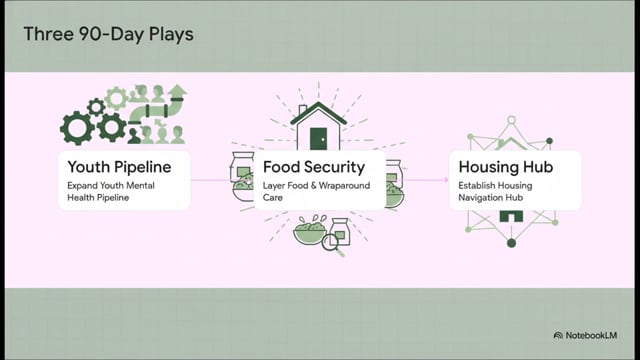
Three community priorities at a glance

The Discovery Brief contains a full 90‑day playbook for each priority. This overview is designed so leadership can quickly compare where the need is greatest and where Sure Foundation has the strongest immediate fit — starting with the grant window opening July 1st.

Play 1 leads — Blue & You Foundation LOI opens July 1–13 · $25K–$250K available

Priority 1 ⚡ Grant Window Open

Youth Mental Health Pipeline

The Need

Arkansas ranks #46 of 51 in youth mental health nationally. In 2023, 60% of AR high school seniors reported persistent sadness — up from 27% in 2015. Jonesboro saw 977 juvenile crime suspects in 2022, a 22% jump year-over-year.

The Play

Expand the existing JPS after-school program at Hope House into a Youth Mental Health Pipeline — tiered SEL, peer mentor "Hope Circles," and direct referral to the on-site licensed therapist.

90-Day Cash $45K – $120K
In-Kind Value ~$42,240/yr
Grant Potential High Tier
View Playbook
Priority 2

Food Security & Wraparound Care

The Need

Arkansas is #1 most food-insecure state in the U.S. (19.4% of households). 79% of Jonesboro School District students are free/reduced-lunch eligible. Hope House already serves 2,000-calorie grab-and-go meals — the asset exists.

The Play

Convert Hope House's grab-and-go service into a Food + Wraparound model — every food encounter becomes an entry point into mental-health screening, SNAP/WIC/ARKids navigation, and follow-up. Partner with FBNEA for pantry distribution.

90-Day Cash $25K – $90K
In-Kind Value ~$35,640/yr
Activation Energy Lowest Lift
View Playbook
Priority 3

Housing Stability Navigation

The Need

Jonesboro has no traditional homeless shelter. Arkansas is the only U.S. state without an implied warranty of habitability. Sure Foundation already holds an $85,000 CDBG award — the prior funder relationship is established.

The Play

Position Hope House as the Housing Stability Navigation hub for Jonesboro — VI-SPDAT assessments, coordinated-entry routing through the AR Balance of State CoC, case management, and on-site therapist access.

90-Day Cash $60K – $175K
In-Kind Value ~$79,200/yr
Grant Alignment Highest Tier
View Playbook

The Strategic Choice: The invitation is not to run all three plays at once. It is to choose one lane, build operational muscle around it for 90 days, learn from the data it generates, and expand from a position of undeniable strength. Sure Foundation's licensed therapist, its JPS partnership, and its Hope House facility make Play 1 the most defensible first move — and the Blue & You LOI window makes July the right moment to act.

Recommended sequence: Play 1 (urgency + grant window) → Play 2 (food infrastructure while Play 1 runs) → Play 3 (housing hub once HMIS and VI-SPDAT certifications are complete).

Why Sure Foundation belongs here

The story of this place

Sure Foundation was not built from scratch. It was sent — by a denomination with a 129‑year calling to place the church in the middle of the need, seven days a week, not just on the Lord's day.

1897 · Origins

A church born to be in the street

Bishop Charles Harrison Mason founded the Church of God in Christ in Memphis in 1897 with a theology that refused to separate spiritual salvation from material care. COGIC grew into the largest Pentecostal denomination in the United States — rooted in Black Southern communities that understood the gospel had to address what a person needed on a Tuesday afternoon, not only on Sunday morning.

Fisher Street COGIC International carried that tradition to Jonesboro, Arkansas. When the congregation recognized that the homelessness, hunger, and mental health crisis had outgrown what a Sunday ministry could address, it did what the best COGIC churches have always done: it built an institution.

111 Fisher St · Growth

One block. Two buildings. One calling.

Sure Foundation — the 501(c)(3) arm of Fisher Street COGIC — grew from a ministry idea into a recognizable Jonesboro institution through three concrete steps. It opened Hope House at 111 Fisher Street: a seven-days-a-week day shelter delivering laundry, hygiene, technology, 2,000-calorie meals, mental-health counseling, and limited medical care to anyone who walks in.

It built a partnership with Jonesboro Public Schools for an after-school program. It earned the City's confidence — an $85,000 CDBG award for supportive services and ADA upgrades. St. Bernards Healthcare lists Hope House in its community-resources directory. For a young nonprofit, that triangle — healthcare anchor, school district, city hall — is uncommonly strong.

2026 · This Moment

The numbers have moved. The moment is now.

Three realities converge in 2026. Arkansas became the #1 most food-insecure state in the country. Arkansas was the only state with a statistically significant rise in suicide deaths from 2022 to 2023. And the City of Jonesboro — now holding a Plan of the Year award for its Health Accelerator Plan — is actively recruiting community partners with data, credibility, and a physical address.

Blue & You Foundation, Foundation for the Mid South, and City CDBG are all naming behavioral health, food security, and housing as priorities — but they require a trusted local intermediary with proven capacity. Sure Foundation is positioned to be that intermediary right now.

The Continuous Calling

Bishop Mason founded the Church of God in Christ in 1897 because he believed the Spirit of God belonged in the street, not only the sanctuary — in the bodies of the poor, the sick, and the forgotten, not only in the hearts of the comfortable. Fisher Street COGIC carried that conviction to Jonesboro. Sure Foundation carried it to 111 Fisher Street, seven days a week, in the form of a shower, a meal, a licensed therapist, and a prayer.

The calling has not changed in 129 years; the names on the door have. Arkansas is now the most food-insecure state in the country. Its suicide rate is rising when every other state's is stable. Its children are the second-most food-insecure in the nation. The same foundation that has held since 1897 is what Sure Foundation is being asked to build on — wider, faster, and with more data in its hands than Bishop Mason ever had. Building On The Sure Foundation is not a motto. It is a mandate.

The Block · North Fisher Street, Jonesboro AR

125 N. Fisher Street

Fisher Street COGIC International

Sanctuary · Congregation · Pastoral leadership · Volunteer base · Spiritual home base for all three plays

111 N. Fisher Street

Hope House · Sure Foundation

Meals · Laundry · Showers · Licensed therapist · After-school · Computer lab · Open 7 days/week

Both buildings · Same block · Same calling · 870-933-0305

Who lives around Sure Foundation

Neighborhood Snapshot · ZIP 72401

ZIP 72401 is the heart of Jonesboro — but it is not Jonesboro's average. Inside this single ZIP, an estimated 29% of residents live below the poverty line, the majority of households rent, and four of every five children attending the surrounding Jonesboro School District qualify for a free or reduced-price school lunch. The neighbors who walk through Hope House's doors are not statistical outliers — they are the median experience of this ZIP.

The Headline Numbers

ZIP 72401 Population
~43,127 EST
Median Age
33.3 YRS
Under 18
24.6% OF JONESBORO
Median HH Income (ZIP)
$45,329
Renter-Occupied Units
~51% OF ZIP
SNAP Households (ZIP)
2,837 ~16%
Poverty Rate (ZIP 72401)
~29% MODELED
Black Poverty Rate (Jonesboro)
41.8% CRITICAL

What the Numbers Hide

The Moderate Poverty Mirage

Craighead County's headline poverty rate is 21.5% — averaged down by wealthier west-side suburbs and ZIP 72404. The ZIP 72401 modeled rate is 29%. The church door opens on the harder side of the county.

The Racial Poverty Gap

Jonesboro's overall poverty rate is 21.3% — but Black residents are at 41.8%, nearly three times the white non-Hispanic rate of 14.4%. "Median Jonesboro" hides a two-tier economy.

Majority-Renter ZIP, Rising Costs

With 8,979 renter-occupied units vs. 4,724 mortgaged owner-occupied, ZIP 72401 is structurally renter-dominant. Median gross rent of $971 against a ZIP median income of $45,329 — the lower half of the distribution is unambiguously cost-burdened.

79% Free/Reduced Lunch

While Jonesboro is celebrated as a growing regional capital, 79% of Jonesboro School District students are free/reduced-lunch eligible — with The Academies At Jonesboro High School at 100%. Four of five children in Sure Foundation's partner schools come from food-precarious households.

The Takeaway: The Jonesboro that markets to investors and the Jonesboro that walks into 111 Fisher Street are not the same city. The aggregate stats describe the first. The household-level data describe the second.

The Bifurcated Reality

Jonesboro The Headline

Arkansas State University's growing campus. $223,200 median home value. Trendsetter Diversity & Inclusion award. The Mall at Turtle Creek. Fifth-largest city in Arkansas and the economic capital of the Northeast.

Jonesboro The Household

41.8% Black poverty rate. 79% free/reduced-lunch eligibility. No traditional homeless shelter. A state that recorded the only statistically significant rise in suicide deaths in the entire country in 2023. The neighbors who walk into 111 Fisher Street every day.

Sources: U.S. Census ACS 2023 · GreatData 2026 · ZipCodes.org · city-data.com · U.S. News Education 2024–25 · CDC NCHS Data Brief 541, 2024

Priority 1 · Highest-urgency visible need · Grant window open July 1

Youth Mental Health Pipeline 90‑Day Playbook

Arkansas ranks #46 of 51 nationally in youth mental health. In 2023, 60% of AR high school seniors reported persistent sadness — up from 27% in 2015. Jonesboro saw 977 juvenile crime suspects in 2022, a 22% jump year-over-year. Sure Foundation already runs an after-school program through Jonesboro Public Schools and employs an on-site licensed therapist at Hope House — a rare combination in a county that the federal government has designated a Mental Health Professional Shortage Area.

The Objective

Expand the existing JPS after-school program at Hope House into a tiered Youth Mental Health Pipeline — universal social-emotional learning at Tier 1, peer mentor "Hope Circles" at Tier 2, and direct referral to the on-site licensed therapist at Tier 3. Pair every cohort with a Youth Mental Health First Aid–trained adult and a peer leader who models help-seeking behavior.

Three On‑ramps · Start where you are

On‑Ramp A · Lowest Lift

Train 6 staff in Youth Mental Health First Aid (~$170/seat). Adopt free CASEL-aligned SEL warmups into the existing after-school program. Refer 10 students to the Hope House therapist over 90 days. Total cash outlay: under $1,100.

On‑Ramp B · Medium Lift

Add 2 part-time peer mentors (~$3,900 each over 13 weeks). Launch weekly Hope Circles for a cohort of 20 students. Establish warm-handoff protocol with the JPS school counselor. Total cash outlay: ~$9,000.

On‑Ramp C · Full Playbook

Hire a 0.5 FTE Youth Pipeline Coordinator ($22–25K annualized). Formalize JPS partnership via MOU. Contract a second therapist for 10 hrs/week. Deploy PHQ-A/GAD-7 baseline and 60-day follow-up screenings across all enrolled youth.

Budget Snapshot

Annual Cash Range
$45,000 – $120,000
Covers coordinator, mentor stipends, therapist contract hours, training, and screening tools.
Volunteer In‑Kind Value
~$42,240 / yr
4 volunteer mentors × 8 hrs/wk × 40 wks × $33/hr federal in-kind rate.
Grant Potential
High Tier
Blue & You Behavioral Health LOI opens July 1–13 · $25K–$250K range.
Existing Asset Base
JPS Partnership + On-Site Therapist
Both in place before Day 1 — rare in a Mental Health HPSA.

Grant Note — Act July 1: Blue & You Foundation Behavioral Health grants awarded $46K–$250K in 2025. LOI window opens July 1–13. Final decisions notified November 11. Also: SAMHSA Project AWARE, Arkansas Community Foundation NE AR Giving Tree, HRSA Rural Communities Mental Health add-on.

Implementation Timeline

Days 1–30

Train & Design

  • YMHFA training for 6 staff members
  • JPS MOU signed and cosigned by principal
  • PHQ-A/GAD-7 screening protocol finalized
  • Parental consent paperwork drafted
  • 2 peer mentors recruited and onboarded
  • Blue & You LOI submitted (July 1–13 window)
Days 31–60

Launch & Run

  • Hope Circles cohort of 20 students launched
  • Baseline PHQ-A/GAD-7 screenings completed
  • Weekly case-coordination: JPS counselor + Hope House therapist
  • Parent night soft launch at Hope House
  • Tier-3 referrals to on-site therapist begin
Days 61–90

Assess & Scale

  • 60-day PHQ-A/GAD-7 re-screenings completed
  • First quarterly metrics report produced
  • Funder/partner site visit hosted at Hope House
  • Follow-on grant applications submitted
  • Decision: sustain at current scale or expand to 40 students

What to Capture

  • 01 Youth enrolled, dosage hours completed, and attendance rate
  • 02 Change in PHQ-A/GAD-7 scores — baseline vs. 60-day follow-up
  • 03 Warm handoffs from Hope Circles into Hope House clinical services
  • 04 Peer mentor retention and mentor well-being growth (self-report)

Risks to Plan Around

Stigma & Parental Refusal: Frame consent as a "wellness check-in," not a mental-health program. Use Fisher Street COGIC's trusted-messenger reputation to reach parents directly before the first session.

Therapist Capacity Ceiling: The on-site therapist cannot absorb unlimited Tier-3 referrals alone. Pre-negotiate a contract with Mid-South Health Systems or ARcare before launch as overflow.

Sustainability Cliff: Blue & You decisions come November 11. Braid with SAMHSA Project AWARE and United Way NEA to avoid a single-funder dependency from Day 1.

Mental Health Thread: This play directly addresses Sure Foundation's core question. Arkansas HS seniors reporting "sad or hopeless" rose from 27% to 60% between 2015 and 2023. School-based mental health services produce a 15% relative reduction in youth suicide attempts [Golberstein et al., Journal of Human Resources, 2024]. Adolescent diagnosed anxiety increased 61% nationally between 2016 and 2023 [HRSA MCH NSCH, 2023]. Play 1 puts Sure Foundation's licensed therapist — already on-site at Hope House — at the center of that response.

Priority 2 · Clearest existing asset base · Run parallel to Play 1

Food Security & Wraparound Care 90‑Day Playbook

Arkansas is the #1 most food-insecure state in the United States (19.4% of households, USDA ERS 2025). One in four Arkansas children is food-insecure. 79% of Jonesboro School District students qualify for free or reduced-price lunch. Hope House already serves 2,000-calorie grab-and-go meals every day — the asset exists. This play converts that service from a standalone transaction into a Food + Wraparound model where every meal encounter opens a door to mental-health screening, SNAP/WIC/ARKids navigation, and follow-up care.

The Objective

Partner formally with the Food Bank of Northeast Arkansas (FBNEA) — headquartered just miles away at 3414 One Place, Jonesboro — for recurring on-site pantry distribution at 111 Fisher Street. Layer a Benefits Navigator role to screen every food client for SNAP, WIC, and ARKids eligibility. Add a weekend Backpack program through Jonesboro Public Schools for the 79% of students in food-precarious households. Connect every encounter back to the Hope House therapist — food is the front door, mental health is the through-line.

Three On‑ramps · Start where you are

On‑Ramp A · Lowest Lift

Sign the FBNEA partner-agency MOU (free). Host one mobile pantry per quarter on the Hope House lot. Logistics cost: ~$1,500. Zero new staff required — existing volunteers manage distribution.

On‑Ramp B · Medium Lift

Monthly on-site pantry plus a Backpack program for 50 students at $4–$5 per backpack per week (~$10,400/yr). Train 2 existing volunteers as benefits navigators using Arkansas DHS portal tutorials.

On‑Ramp C · Full Playbook

Client-choice pantry open 2 days/week. Hire 0.5 FTE Food + Benefits Navigator (~$22K). Integrate with FBNEA TEFAP commodity distribution. Every food client screened for SNAP/WIC/ARKids eligibility and offered a warm handoff to the on-site therapist.

Budget Snapshot

Annual Cash Range
$25,000 – $90,000
Covers navigator salary, backpack supplies, pantry logistics, cold storage, and training.
Volunteer In‑Kind Value
~$35,640 / yr
Based on volunteer distribution and navigation hours at federal in-kind rate.
Activation Energy
Lowest of Three Plays
Hope House meals already running. FBNEA is a Jonesboro neighbor. On-ramp A can launch within 30 days.
Key Infrastructure Need
Refrigerator/Freezer Unit
$4–6K capital item — eligible for CDBG capital match alongside the ADA upgrade award.

Grant Note: USDA Community Food Projects Competitive Grant Program (CFPCGP, $50K–$400K); Walmart Foundation AR community grants; Arkansas Hunger Relief Alliance mini-grants; Tyson Foods hunger relief (AR HQ); Conagra Brands Foundation.

Implementation Timeline

Days 1–30

Partner & Prepare

  • FBNEA partner-agency MOU signed
  • Civil-rights and EOP training completed (USDA requirement)
  • Intake/storage area designated at Hope House
  • 10 volunteers recruited and trained on distribution
  • Refrigerator/freezer unit quoted and ordered
Days 31–60

Launch & Pilot

  • First on-site FBNEA distribution hosted
  • Backpack pilot launched with 25 students at one JPS elementary
  • Navigator trained on Arkansas DHS SNAP/WIC portal
  • First benefits-screening cohort tracked in spreadsheet
  • Warm-handoff protocol with Hope House therapist established
Days 61–90

Scale & Report

  • Backpack program scaled to 50 students
  • First benefits-navigation cohort report produced
  • "Food + Mental Health" community event hosted at Hope House
  • SNAP/WIC approvals documented for grant reporting
  • USDA CFPCGP application scoped for next cycle

What to Capture

  • 01 Individuals served per distribution — first-time vs. repeat visits
  • 02 SNAP/WIC/ARKids applications initiated and approvals confirmed
  • 03 Backpacks distributed and student attendance correlation at JPS
  • 04 Cross-referrals from food encounter to Hope House mental-health services

Risks to Plan Around

USDA/TEFAP Compliance Burden: Partner as an FBNEA sub-distribution site rather than a primary TEFAP agency — FBNEA holds the primary compliance burden. Sure Foundation inherits the distribution infrastructure without the regulatory overhead.

Cold/Dry Storage at 111 Fisher: A $4–6K refrigerator/freezer unit is required before accepting FBNEA perishables. Budget this as a capital line item and seek CDBG match alongside the existing ADA upgrade award.

Volunteer Burnout: Distribution days are physically demanding. Plan quarterly appreciation events and recruit fresh cohorts via ASU service-learning — the Honors College already partners with FBNEA.

Mental Health Thread: Becoming food-insecure produces measurable increases in clinically-relevant anxiety and depression within a single month — reversed just as quickly when food security is restored [Bateson et al., PLOS Mental Health, 2025]. Food-insecure adults face 257% higher risk of anxiety and 253% higher risk of depression [ORF / Suri & Ray, 2025]. Every food encounter at Hope House is a mental-health access point — the wraparound model makes that connection explicit and trackable for funders.

Priority 3 · Highest grant-funding alignment · Activate once HMIS certified

Housing Stability Navigation 90‑Day Playbook

Jonesboro has no traditional homeless shelter — the Salvation Army's 17 beds are the city's entire supply. Arkansas is the only U.S. state without an implied warranty of habitability, meaning landlords face no legal obligation to provide safe, sanitary rentals. Craighead County eviction filings spiked 150% in a single month during the 2020 housing shock. Sure Foundation has already received an $85,000 CDBG award to expand homeless services — the prior funder relationship is established. This play formalizes what Hope House is already doing informally and positions it as the city's Housing Stability Navigation hub.

The Objective

Position Hope House at 111 Fisher Street as the single physical door in Jonesboro where unhoused or eviction-threatened residents can be assessed using the VI-SPDAT, routed into the Arkansas Balance of State CoC via the Northeast Arkansas Coalition coordinated entry, receive case management, and be connected to the on-site therapist. Formalize what is happening informally — and make it legible to funders with the data infrastructure (HMIS, VI-SPDAT, case notes) that federal and state housing grants require.

Three On‑ramps · Start where you are

On‑Ramp A · Lowest Lift

Train 2 staff in VI-SPDAT assessment (~$2,500 training/HMIS setup). Become a coordinated-entry access point for the Northeast Arkansas Coalition. No new hires required. Start routing Hope House visitors with housing instability into the CoC system immediately.

On‑Ramp B · Medium Lift

Add 0.5 FTE Housing Navigator (~$22K annualized). Become an HMIS-reporting agency. Case manage a cohort of 20 households — VI-SPDAT assessment, goal-planning, and CoC routing for each. Begin documentation for the CDBG Public Services application.

On‑Ramp C · Full Playbook

Apply as CDBG-funded subrecipient for rental assistance ($50K–$150K). Launch an eviction-prevention micro-grant fund ($10–25K revolving). Formalize MOU with Legal Aid of Arkansas. Contract a part-time therapist specifically for housing-instability clients — addressing the 59% depression rate among eviction-threatened renters.

Budget Snapshot

Annual Cash Range
$60,000 – $175,000
Covers navigator salary, HMIS license, micro-grant revolving fund, therapist contract hours, and rental assistance administration.
Volunteer In‑Kind Value
~$79,200 / yr
Highest in-kind value of the three plays — reflects the depth of case-management volunteer hours.
Grant Alignment
Highest of Three Plays
CDBG, HUD CoC, ESG, ADFA, Foundation for the Mid South — all active funding streams.
Prerequisite
HMIS License + VI-SPDAT Cert
60–90 day lead time. Begin certification during Play 1 and 2 execution to be ready for the next CDBG cycle.

Grant Note: City of Jonesboro CDBG Public Services (prior funder at $85K); HUD CoC via AR Balance of State; ESG via Arkansas DHS; ADFA National Housing Trust Fund; Foundation for the Mid South (reopening 2025); Bezos Day 1 Families Fund; Enterprise Community Partners rural-South grants.

Implementation Timeline

Days 1–30

Certify & Connect

  • Apply for HMIS license through AR Balance of State CoC
  • VI-SPDAT certification for 2 staff members
  • Partner meeting: St. Bernards Recuperative Care, The Promise House, Salvation Army, JURHA
  • Legal Aid of Arkansas MOU conversation initiated
  • Review prior CDBG award documentation for compliance baseline
Days 31–60

Assess & Route

  • Coordinated-entry access point goes live at Hope House
  • VI-SPDAT assessments begin for all Hope House visitors with housing instability
  • Eviction-prevention micro-grants piloted for 5 households (~$5,000)
  • Housing-instability clients offered warm handoff to on-site therapist
  • CDBG 2025 application narrative drafted
Days 61–90

Report & Apply

  • First 90-day outcomes report delivered to CoC
  • CDBG 2025 Public Services application submitted
  • Pilot micro-grant evaluation — tenancy retention at 90 days
  • Present outcomes to Mayor's office (Health Accelerator Plan alignment)
  • Decision: scale Navigator to 1.0 FTE or hold at 0.5 FTE

What to Capture

  • 01 VI-SPDAT assessments completed and successfully routed into CoC
  • 02 Households diverted from eviction — micro-grant recipients with retained tenancy at 90 days
  • 03 Placements into permanent or transitional housing (CoC-reportable metric)
  • 04 Cross-referrals from housing intake into mental-health and food wraparound services

Risks to Plan Around

Demand Exceeds Navigator Capacity: Cap intake at 20 households in the pilot cohort. Establish warm-handoff agreements with The Promise House and Salvation Army before launch — never turn someone away cold.

HMIS Data-Entry Burden: Budget for the HMIS license fee and scope a Year 2 data-entry clerk. Underfunding data infrastructure is the most common reason small nonprofits lose CoC eligibility after the first cycle.

Parallel Program Risk: If the City of Jonesboro launches its own coordinated-entry program directly, position Sure Foundation as a CoC subrecipient rather than a parallel access point — never build infrastructure the city already plans to build.

Structural Grant Advantage: Federal housing program officers — CDBG, HUD CoC, ESG — actively look for three things: institutional backing (Fisher Street COGIC at 125 N. Fisher, with a congregation, a building, and a track record), nonprofit governance (Sure Foundation's 501(c)(3) with a prior CDBG award and compliance history), and community rootedness (a permanent physical address at 111 N. Fisher Street that the neighborhood already knows). Most peer faith-based nonprofits in NE Arkansas have one of these three. Sure Foundation has all three.

Mental Health Thread: Renters at perceived risk of eviction show 59.3% depression prevalence vs. 37.0% among non-at-risk renters, and 67.0% anxiety vs. 43.3% [Acharya et al., 2022]. The housing navigator and the on-site therapist are not separate services — they are the same door, walked through in sequence, by the same person in crisis.

Building On The Sure Foundation 2026

From Brief to Action

Suggested next steps for Sure Foundation

This Discovery Brief surfaces one decisive question for leadership: Which one of these three doors will Sure Foundation open first — and who needs to be sitting at the table when that decision is made?

1

Pray & Align on Reality

Begin with a season of communal prayer over the Neighborhood Snapshot. Ask for God's heart for the neighbors at 111 Fisher Street and throughout ZIP 72401 — that leadership shares the same clear, data-grounded, empathetic picture of the burdens those neighbors are carrying before any play is selected.

2

Submit the Blue & You LOI — July 1–13

Regardless of which play leadership chooses to run first, the Blue & You Foundation Behavioral Health LOI window opens July 1–13. The LOI is short, free, and opens a $25,000–$250,000 relationship. Submit it now. Fund the decision later. The 2025 award range was $46,000–$250,000 for organizations with Sure Foundation's profile.

3

Discern the Right Play

Using the Youth Mental Health Pipeline, Food Security, and Housing Stability sections of this brief, discern where Sure Foundation has the strongest immediate fit — where volunteer capacity, existing partnerships, Hope House infrastructure, and the Spirit's leading intersect. The recommended starting sequence is Play 1 → Play 2 running parallel → Play 3 once HMIS and VI-SPDAT certifications are complete.

4

Decide, Commit, and Launch

Make a firm leadership decision to treat the chosen play as a 90-day pilot. Set clear metrics before Day 1. Schedule monthly reflection points to sustain, scale, or shift based on what the data and community stories reveal. Produce a single 90-day outcomes dashboard that becomes the asset every funder cycle asks for.

A Single Decision for Fisher Street

As Sure Foundation walks out the calling that Bishop Mason planted in 1897 and Fisher Street COGIC carried to Jonesboro — Building On The Sure Foundation — which play is God inviting Sure Foundation to lead with in the next 90 days?

Once a play is selected, Community Playbook can stand alongside Sure Foundation's leadership to prayerfully refine implementation, translate 90-day outcomes into the next strategic season, and support grant applications as they come due.

Funding Landscape

Who funds this work in Arkansas

12 funders actively naming behavioral health, food security, and housing as priorities — with active or imminent windows. Sure Foundation's church + 501(c)(3) structure is a competitive advantage with federal program officers.

FunderPlay MatchTypical Range
Blue & You Foundation
Behavioral Health
Play 1 — Youth Mental Health$25K–$250K
City of Jonesboro CDBG
Prior funder at $85K
Play 3 — Housing · All plays$25K–$150K
HUD Continuum of Care
AR Balance of State
Play 3 — Housing Stability$50K–$250K
SAMHSA Project AWARE
Federal NOFO
Play 1 — Youth Mental Health$100K–$500K
USDA CFPCGP
Community Food Projects
Play 2 — Food Security$50K–$400K
Arkansas Community Foundation
NE AR Affiliates
Cross-cutting · All plays$5K–$35K
United Way of NE ArkansasCross-cutting · All plays$10K–$50K
Foundation for the Mid South
Reopening 2025
Health · Financial security$25K–$75K
Walton Family Foundation
AR Home Region
Youth · Education · Community$25K–$250K+
Tyson Foods Hunger Relief
AR HQ
Play 2 — Food Security$5K–$100K
Lilly Endowment
Community Renewal
Faith-based community$50K–$1M
St. Bernards Development Foundation
Local anchor
Healthcare-adjacent · All plays$5K–$50K

Structural Advantage: Sure Foundation's church + 501(c)(3) architecture — Fisher Street COGIC (institutional backing) + Sure Foundation EIN 81-4561662 (nonprofit governance) + 111/125 N. Fisher Street (community rootedness) — checks all three boxes federal program officers look for simultaneously. Name this structure explicitly in every grant narrative.

Implementation Support

How Community Playbook supports this work

Sure Foundation does not have to build a community strategy, data infrastructure, and partner network from scratch. Community Playbook provides the tools and coaching to turn a chosen 90-day play into a repeatable, high-impact ministry rhythm.

Platform Tools

Digital tools that organize plays, partners, and metrics in one place so staff and lay leaders always know what is happening.

  • Playbook Library templates
  • PartnerWell Directory mapping
  • Household Impact tracking

Implementation Coaching

Personalized guidance to adapt plays to Sure Foundation's specific culture, reducing trial-and-error for staff and volunteers at Hope House.

  • Launch planning & roles
  • Intake & follow-up workflows
  • Grant-readiness preparation

Reporting & Discernment

Translation of data into clear dashboards and funder-ready summaries that inform what Sure Foundation should run next — and what to say to Blue & You in November.

  • Quarterly snapshots for leaders
  • Shadow budgets & in-kind value
  • 90-day learning summaries

Scalable Support

Community Playbook can come alongside Sure Foundation at different levels — from light-touch guidance on a single 90-day pilot to mapping the entire NE Arkansas ecosystem of care for a multi-year strategy rooted in 111 and 125 N. Fisher Street.